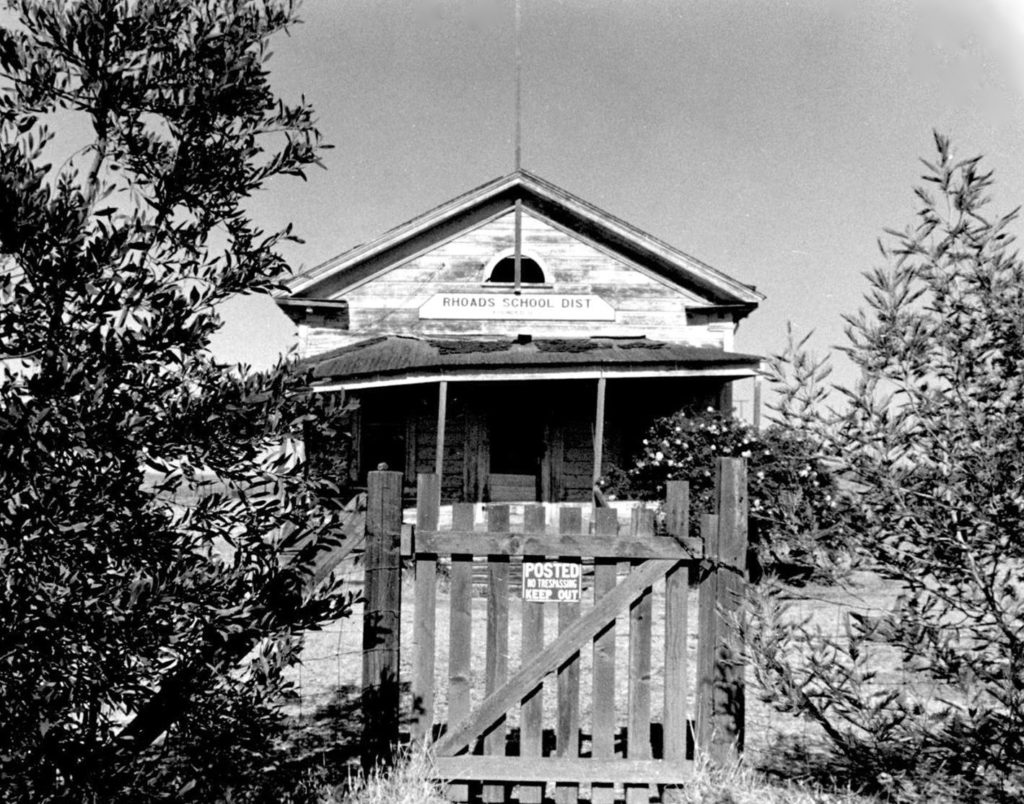
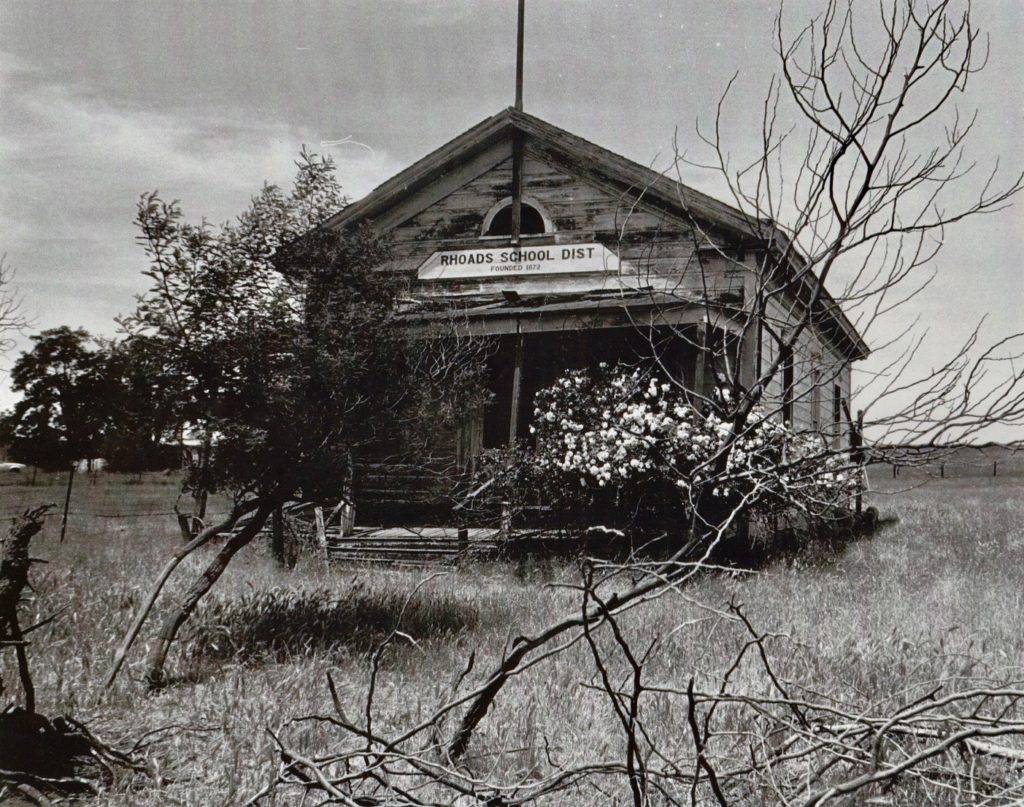
Two Schools – Pioneer Jared Dixon Sheldon built the first Rhoads School in the 1850’s. It was close to the Cosumnes River, which was subject to flooding. Children became sick one year from mosquito bites, which we now assume was malaria, so the school was closed in 1867. In 1872 the second Rhoads School was built on Sloughhouse Road as a community effort. Its financing was by public subscriptions, cake and pickle sales, and a benefit ball with tickets at $3.50 each. Total expenditures were $1,312.60, which included the schoolhouse, insurance and some simple furnishings; desks for students, a desk and chair for the teacher, a stove, a broom, bucket, and dipper.
John P. Rhoads – Both schools were named for John P. Rhoads, who had arrived in California from Illinois in 1846. The Rhoads wagon train traveled part of the way with the Donner Party, though the Donner’s were about three weeks behind them as the Rhoads family passed the Great Salt Lake. History has revealed the tragedy that met the Donner Party as they attempted to cross the mountains in what proved to be an unusually ferocious winter. John P. Rhoads was one of seven men who volunteered for a rescue party and bring survivors to safety. In all, he made three rescue missions.
1872 to 1946 – The school opened in May with Agnes S. Jaycoax as teacher. There were 21 students enrolled, with an average daily attendance of 15. All teachers were required to be at least 18 years of age and to hold a valid teaching credential. They were usually young, unmarried women. Teacher’s salaries at Rhoads from 1872 to 1906 ranged from $55.00 to $84.80 a month, including room and board at the home of a local family.
Drinking water was carried by bucket from the well across the road at the Taylor (later Murphy) ranch. The bucket with a dipper in it sat on a wooden bench in the cloakroom. The children drank from the dipper and returned it to the bucket. The Taylors and Murphy’s also allowed watering trough privileges for the horses of the children who rode to school. Besides carrying water, students’ chores included hauling wood. The stove in the middle of the classroom, and was the schools only source of heat. There was no artificial light and on very dark days, kerosene lanterns were lit or class was dismissed early. The schoolyard was large, but not improved, had very little play equipment, and only one outhouse. After the first year, a second outhouse was built. The boy’s was northeast of the school – the girl’s was to the southwest.
Graduation exercises were usually school performances and entertainments. Usually, no more than 5 or 6 students graduated, and some years no one or only one. Students traveled to Sacramento to take graduation examinations to allow them to go on to high school. In 1946 the Rhoads, Michigan Bar, Stonehouse and Wilson Districts combined into the Cosumnes River Union School District. In 1959 the Cosumnes Union School district became part of the Elk Grove Unified School District.
The Move to the Elk Grove Park
In 1976, the Bicentennial Year, the Rhoads School was moved from its home on Sloughhouse Road to Elk Grove Park. The Murphy family gave the school to the Sacramento County Parks Department. Members of the community contributed hundreds of hours over a year to restoring the deteriorating building and returning it to it’s original appearance around the end of the 19th century. With the school in Elk Grove Park, the newly formed Elk Grove Historical Society assumed the responsibility of administering it for the community. Today the Rhoads Schools serves two purposes. It is a living History Program for school classes in the Sacramento County area, and it is also a museum that is open to the public several days of the year and during special events at the Elk Grove Park.
It is open for free tours every first Saturday of the month (June-September) from 1:00 p.m. to 4:00 p.m. when the Stage Stop Museum is also open.